 Sripath Foods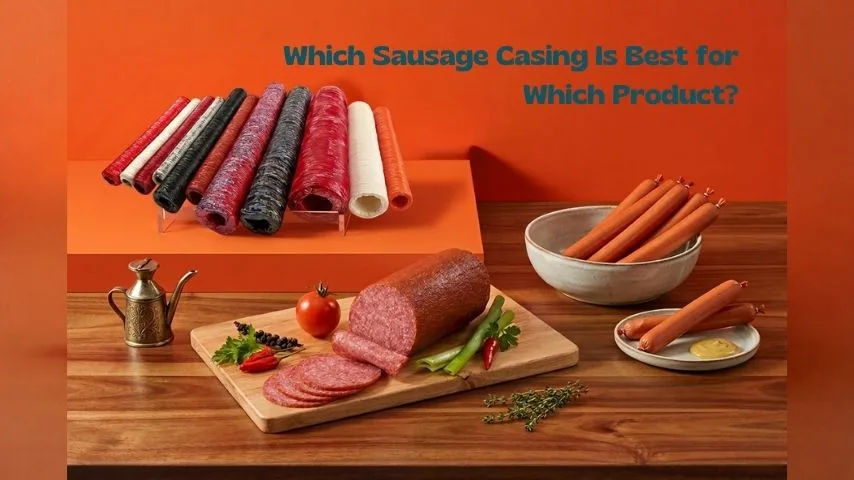
If you manufacture sausages in India, the wrong casing can cost you on product quality, processing speed, shelf life, and margins. The right one depends on your product: fresh, smoked, skinless, fermented, or retortable ready-to-eat.
This guide matches cellulose, fibrous, collagen, and plastic casing to the right sausage product, using ViskoTeepak's real product lines — Wienie-Pak, Nippi, Fibran, ST/Max/Super Protect, and Nova.
The Four Casing Types, at a Glance
Cellulose (Wienie-Pak) — permeable, peels cleanly after cooking. The standard for skinless sausages: hot dogs, frankfurters, beer sausages, mini salamis.
Fibrous (ST / Max / Super Protect) — reinforced with abaca fibre for high tensile strength. The standard for large-diameter, long-cure products: salami, pepperoni, luncheon meats.
Collagen (Nippi edible / Fibran non-edible) — uniform diameter, strong machine performance. Best for fresh sausage, cooked sausage, and snack formats.
Plastic (Nova Core / Shape / Permeable) — non-permeable, the strongest oxygen and moisture barrier. Best for retortable, shelf-stable, and ambient ready-to-eat products.
Match Your Product to Its Casing
• Fresh sausages → edible collagen (Nippi) for a clean bite and consistent machine performance.
• Smoked sausages → cellulose for skinless formats; collagen when the casing stays on.
• Fermented / dry-cured (salami) → fibrous, for shape retention through long curing and drying.
• Skinless sausages → cellulose, for clean peeling at high production speed.
• Retortable & ready-to-eat → plastic, for the strongest barrier and longest shelf life.
• Snack sausages → small-calibre edible collagen, for consistent, efficient high-speed output.
Key Differences That Actually Matter
• Permeability: cellulose and fibrous are permeable (good for smoking/curing); collagen is moderate; plastic is non-permeable by default, with a Permeable series available.
• Edibility: only collagen (Nippi range) is edible; the rest are peeled off.
• Machine compatibility: collagen and cellulose run fastest on automated lines; fibrous suits larger formats; plastic is chosen for barrier and print, not speed alone.
• Shelf life: plastic casing wins decisively on barrier-driven shelf life.
How to Choose
Ask: Is the product fresh, cooked, smoked, fermented, or retortable? Does it need to be edible? Will it be peeled after cooking? Do you need smoke permeability, or barrier protection? What does your stuffing/linking equipment support? The answers narrow your choice fast — and a free sample confirms it on your own line.
Why Casing Selection Matters for Indian Processors
Casing choice affects stuffing speed, cooking performance, peelability, Halal compliance, and customer satisfaction. In India specifically, climate and humidity make mould resistance important for dry-cured products, and a large share of the processed meat industry requires Halal-certified supply.
Sripath Foods: Your Sausage Casing Partner in India
Sripath Foods, based in Coimbatore, Tamil Nadu, is India's exclusive importer, supplier, wholesaler, and distributor of ViskoTeepak's full casing range — collagen, cellulose, fibrous, and plastic. Every range carries GFSI-recognized food safety certification, ISO 9001, Kosher, and Halal certification, plus EU/US food-contact compliance. Minimum order is as little as 1 box, with a free sample available before you commit to bulk.
Want the full technical breakdown? Read our complete guides to fibrous casing, plastic casing, and all four casing types.
📧 enquiry@sripathfoods.com | 📞 +91 99944 02911
Order Free Samples · Get a Price Quote