 Sripath Foods
Introduction
Walk onto any modern sausage production line and you'll find that the casing is doing far more work than simply holding the meat together. It shapes how the finished product looks on a retail shelf, how evenly it cooks and smokes, how it slices, and how long it stays fresh once it's packed. Get the casing wrong for the job, and you can end up with breakage on the stuffing line, uneven colour after smoking, inconsistent diameters that throw off your weight control, or a product that simply doesn't hold up through distribution.
That's why casings have become a deliberate engineering decision rather than an afterthought for meat processors. The right casing affects:
- Product appearance and presentation
- Texture and bite
- Cooking and smoking performance
- Shelf life
- Production speed and line efficiency
- Food safety
- Brand presentation on retail packaging
Collagen, cellulose, fibrous and plastic casings have each been engineered for specific parts of this job, and modern industrial meat processing depends on being able to pick the right one for each product. This guide walks through what each casing type is, where it's used, how to choose between them, and why the choice matters more than it might seem at first glance.
What Are Sausage Casings?
A sausage casing is the tubular material that ground or emulsified meat is stuffed into before cooking, smoking, curing or freezing. Traditionally this was animal intestine ("natural casing"), but the vast majority of industrial meat processing today runs on manufactured casings — collagen, cellulose, fibrous and plastic — because they solve problems natural casing can't at scale.
Manufactured casings give processors uniform diameter from the first metre to the last, which natural casing simply cannot guarantee. They're manufactured to consistent tensile strength, so they run reliably through automated stuffing and linking equipment at high speed with far less breakage. They can be tailored — for smoke permeability, for printability, for shrink behaviour, for shelf life — in ways natural casing cannot be. And because they're produced under controlled industrial conditions rather than sourced from animal by-products, they simplify sourcing, food-safety documentation and supply consistency.
This is why demand for manufactured sausage casings continues to grow across global food processing: they are what makes consistent, high-speed, industrial-scale sausage production possible in the first place. Any meat processor scaling up production, standardising product quality, or exporting to markets with strict food-safety requirements eventually runs into the same question — which casing type actually fits this product and this process?
Types of Sausage Casings
Cellulose Casings
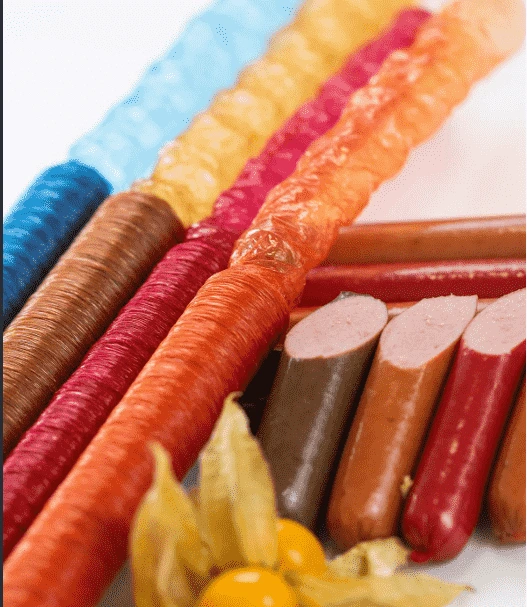
Cellulose casing is made from regenerated cellulose, extruded into a strong, small-caliber tube. It's smoke, air and moisture permeable, which is exactly what's needed for the fast, high-volume production of skinless sausages. The casing is shirred onto a stuffing horn, filled at high speed, then peeled away after cooking and smoking — leaving the familiar skinless finish on the finished product.
Its main advantages are efficiency and consistency: cellulose casing is available in a very wide range of calibers and colours, can be printed for branding, and is engineered for rapid, clean peeling on automated lines (ViskoTeepak's Rapid Peel and D-Tech ranges, for example, are built specifically around fast, reliable peeling at industrial speed). Because it shrinks and tightens around the sausage after stuffing, it also gives excellent shoulder formation and a well-defined, consistent shape batch after batch.
Typical applications: hot dogs, frankfurters, beer sausages and mini-salamis — essentially any skinless sausage produced at volume across the meat processing industry.
Collagen Casings
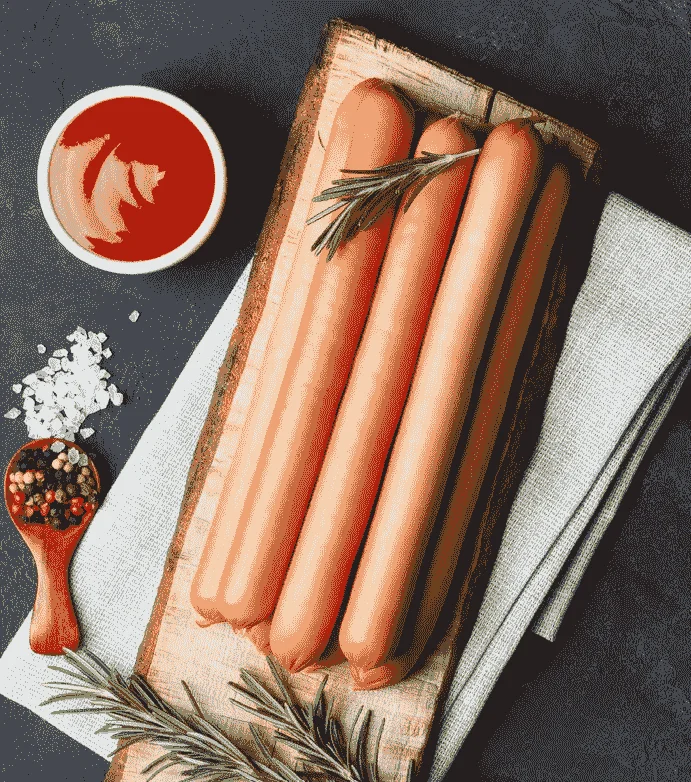
Collagen casing is made from purified collagen protein and comes in two distinct categories: edible and non-edible. Edible collagen casing is designed to be eaten along with the sausage and is used for fresh, cooked and smoked sausages where a tender bite matters. Non-edible collagen casing is peeled off before the product is eaten and is generally used for larger-caliber, cured or cooked products.
What makes collagen casing valuable on an industrial line is its uniformity. Diameter control is tight and consistent from casing to casing, it runs cleanly through automated stuffing and linking machinery, and it holds up at the high speeds modern production lines demand. Sripath Foods supplies both edible and non-edible collagen casings through its partnership with ViskoTeepak — the Nippi range for edible applications and the Fibran range for non-edible, cured and cooked products.
Typical applications: fresh sausages, snack sticks, breakfast sausage, and cooked sausages such as chorizo and andouille, widely used across the meat processing industry. Within the Nippi edible range, R-type is the general-purpose casing for processed and smoked sausage, K-type and CK-type are built for an alternative bite on products like snack sticks and cupping pepperoni, and NF is designed specifically for fully cooked fresh sausage with reduced sticking during pan-frying.
Fibrous Casings
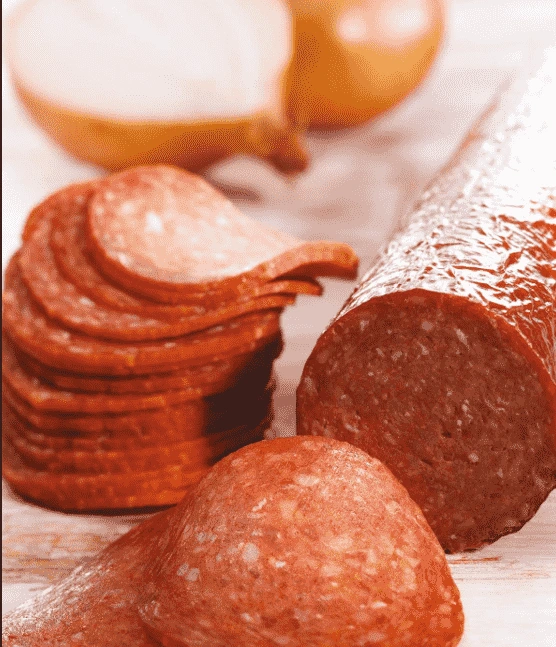
Fibrous casing is a reinforced cellulose casing — cellulose strengthened with natural long-fiber abaca (manila hemp) paper, giving it significantly higher tensile strength than standard cellulose casing. That extra strength and dimensional stability is exactly why it's the standard choice for products that go through long curing, drying or smoking cycles.
Fibrous casing offers excellent smoke permeability for even colour and flavour development, outstanding slicing performance with very tight diameter control (critical for retail-sliced deli meats), and strong printability — up to six colours in some ranges — for branded retail packaging. It's also the most suitable casing family for products that need to hold their shape and structure over extended ripening or curing periods.
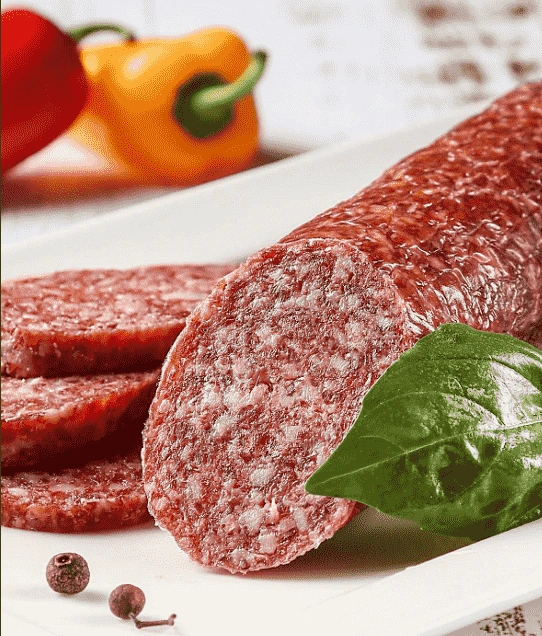
Typical applications: salami, pepperoni, bologna, mortadella and cooked ham — anywhere precise, consistent slicing and long-process durability both matter across the meat processing industry. Within the fibrous family there's also meaningful variation: ViskoTeepak's Standard (ST) range is the general-purpose workhorse, Max is optimised for a wider stuffing-tube diameter and faster output, and Super Protect is purpose-built for demanding white-mould salami where standard fibrous casing would otherwise be broken down by the mould's own enzymes during ripening.
Plastic Casings
Plastic casing (ViskoTeepak's Nova range) is engineered from one or more layers of food-grade plastic resins, extruded and in many cases stretched and annealed for specific mechanical properties. Its defining advantage over the other three casing families is barrier performance: plastic casing offers the strongest resistance to oxygen and moisture transmission, which directly extends shelf life.
Beyond barrier properties, plastic casing holds its shape reliably through cooking and cooling — important for molded and portion-controlled products — and supports a wide range of shrink levels and adhesion properties depending on the product. It's a strong fit anywhere shelf life and shape stability matter more than smoke permeability.
Typical applications: cooked ham, luncheon meat, processed cheese and poultry rolls across the meat processing industry. ViskoTeepak's Nova line is itself split by application: the Core series is built for round products like mortadella and pâté, the Shape series for molded and D-shaped products, and the Permeable series bridges the gap by allowing cured and smoked products to be produced in plastic casing while still developing a natural, artisan appearance.
Comparison Table
The table below summarises how the four casing families compare across the factors that matter most on a production line — edibility, smoke permeability, machine speed, printability and typical best-fit product. It's a starting point for narrowing down your options, not a substitute for testing a sample against your own process.
| Feature | Cellulose | Collagen | Fibrous | Plastic |
|---|---|---|---|---|
| Edible | No | Yes / No | No | No |
| Smoke Permeability | High | Medium | High | Low |
| Machine Speed | Excellent | Excellent | Very Good | Very Good |
| Printing | Limited | Limited | Excellent | Excellent |
| Best For | Hot Dogs | Fresh Sausage | Salami | Cooked Ham |
A few of these rows are worth unpacking. Edibility only applies cleanly to collagen — edible collagen casing (Nippi) is eaten with the product, non-edible collagen (Fibran), cellulose, fibrous and plastic casings are all peeled away before the product reaches the consumer. Smoke permeability is really a proxy for how the casing behaves during curing and smoking: cellulose and fibrous both allow smoke and moisture to pass through freely, which is why they dominate smoked and cured product categories, while plastic casing's low permeability is a deliberate trade-off — it sacrifices smoke transfer for a much stronger oxygen and moisture barrier, which is exactly what extends shelf life on cooked, sealed products.
Machine speed reflects how forgiving each casing is on high-speed automated stuffing and linking equipment — cellulose and collagen were both built from the ground up for this, which is why they're the default choice for high-volume hot dog, frankfurter and snack-stick lines. Printing capability matters most for retail-facing products sold with the casing left on; fibrous and plastic casings both support multi-colour printing (up to six colours in some ViskoTeepak ranges) for branded packaging, while cellulose and collagen casings are more commonly used in applications where the casing is peeled away before sale, so printing is less of a priority for those product lines.
How to Choose the Right Sausage Casing
Rather than starting from a list of casing features, it's more useful to start from your product and process, and work backward to the casing that fits:
- Product type — a fresh breakfast sausage, a long-cured salami, and a cooked luncheon loaf each favour a different casing family entirely.
- Cooking process — is the product fried, steam-cooked, or left raw/fresh for the customer to cook? This affects which casing will perform best under heat.
- Smoking requirements — heavily smoked products need high smoke permeability (fibrous or cellulose); products that aren't smoked at all can use plastic casing's superior barrier properties instead.
- Storage conditions and shelf-life goals — if extended shelf life is the priority, plastic casing's barrier performance usually wins out.
- Production volume and stuffing equipment — your existing horn diameters, linking equipment and line speed all constrain which casing calibers and constructions will actually run cleanly.
- Finished appearance — retail branding needs (printed casing, consistent colour, a particular sheen or matte finish) can be a deciding factor on their own.
In practice, most processors land on the right casing family quickly once the product and process are clear, then fine-tune within that family (caliber, colour, coating, construction) based on a physical sample run on their own equipment.
Why Quality Casings Matter
The cost difference between a well-specified casing and the wrong one rarely shows up as a line item — it shows up as breakage on the stuffing line, unplanned downtime while operators clear jams, product rejects from inconsistent diameter or weight, and a slow trickle of customer complaints about appearance or texture. None of that is cheap, and all of it is avoidable with the right casing correctly matched to the process.
Consistent, well-manufactured casings reduce weight variation batch to batch, cut down on production waste, and keep a line running at the speed it was designed for. For a processor running thousands of metres of casing a day, that consistency compounds directly into fewer rejects and lower operating cost — which is really what "quality casing" means in practice.
Why Choose Sripath Foods?
Sripath Foods is India's exclusive importer, supplier, wholesaler and distributor for ViskoTeepak's full casing portfolio — collagen (Nippi and Fibran), cellulose (Wienie-Pak), fibrous, and plastic (Nova) — giving processors a single, trusted source for whichever casing family their product needs, instead of managing multiple vendors.
Every casing range we supply carries GFSI recognized food safety certification, ISO 9001, Kosher and Halal certification, and EU/US food-contact compliance, backed by consistent supply and technical guidance on matching a casing to your specific product and equipment. We work with meat processors, food manufacturers and OEM/private-label brands across India, and we keep the minimum order accessible — 1 box, with a free 50g sample available so you can test a casing on your own line before committing to a bulk order.
Conclusion
Collagen, cellulose, fibrous and plastic casings each solve a different production problem — edible tenderness, high-speed skinless production, long-cure durability and slicing precision, or extended shelf life through barrier performance. Choosing the right one isn't about picking the "best" casing in general, it's about matching the casing family and construction to your specific product, process and equipment.
Getting that match right improves product consistency, cuts waste and downtime, and gives your finished product the appearance and shelf life your customers expect. If you're not sure which casing fits your process, contact Sripath Foods — we can help you match the right casing to your application from our full ViskoTeepak collagen, cellulose, fibrous and plastic range.